4 teammates
5 weeks
As part of my course Evaluation and User Studies, this project focused on understanding the eating habits, dietary strategies and nutritional needs of elite athletes. The primary goal was to gather detailed, first-hand insights that could inform future UX design solutions for this unique target group.
This project targets users with highly specific daily routine, distinct goals and unique preferences that differ significantly from the general population. Secondary research provided general knowledge about nutrition and supplementation which was magnified through a nuanced understanding drawn from a triangulation of a qualitative and quantitative data collection.
- Elite athletes’ eating habits differ depending on sport, gender, age and competition level. There is limited first-hand research on behaviors and needs from a UX perspective.
- It was challenging to find willing participants and to collect data that was both comprehensive and focused, avoiding it becoming too scattered or too narrow.
- Elite athletes lead a unique daily life, with distinct needs, preferences, and objectives that differ from my own experience
- Secondary research was used to define the target users. The project began with gathering research regarding eating habits, dietary supplements and nutritional needs.
- Qualitative and quantitative data collection was tailored after the target group's unique everyday life and habits.
- Thematic analysis and affinity mapping, combined with numerical analysis, provided both a holistic overview and detailed insights, which were visualized to identify clear patterns and differences.
- It was valuable managing a large amount of data from different methods and triangulating it to generate concrete, actionable insights.
- I found it very rewarding working with users whose daily life, needs, and goals are very different from my own.
- I became more aware of how my own assumptions can shape research, and how to reduce bias by grounding decisions in data rather than expectations
"
Elite athletes compete at the highest national level (junior or senior) or in national championships
- Definition from Swedish Sports Confederation (“Riksidrottsförbundet”)
The project has been limited to physically active sports
Many elite athletes need up to 5000 kcal per day, compared to about 2000 kcal for someone who is not training intensely.
Diet typically includes 50–60% carbohydrates, one-third fats, and essential micronutrients such as vitamin D, magnesium, and iron.
Protein is especially important in strength- and muscle-based sports.
The use of supplements is common, particularly creatine, caffeine, protein, and beta-alanine.
Female athletes are at higher risk of low energy availability, which can lead to hormonal issues and long-term health problems.
Social media, body ideals, time pressure and available resources are influential factors on unhealthy eating habits, despite good knowledge.
The survey was created to explore how elite athletes adapt their eating habits to perform at a high level. It is structured in 2 parts: Demographic questions with age, gender and their sport, and information about eating their current habits. Two open questions were implemented regarding nutrient tracking and dietary challenges.
Before publication expert reviews and user tests were conducted. Questions were examined as if we had no prior knowledge to identify anything unclear or confusing and external participants evaluated clarity, relevance and cohesion.
The survey was distributed on November 11th to several universities and sports organizations across Sweden. Unfortunately, only a total of 43 responses were collected. An English version was also made but received no responses.


The data analysis began with a univariate review of all survey questions, choosing suitable visualizations such as pie charts, bar charts, and frequency tables. The aim was to identify patterns and differences related to gender, sport, age and eating habits.
Gender differences were explored through several bivariate analyses, including supplement use, number of meals per day and reasons for nutrient tracking. A multivariate analysis examined the relationship between gender, sport and reported dietary challenges. Given that only a single participant identified as non-binary, the subgroup size was insufficient to support reliable or generalizable statistical analysis.
Differences between competition levels were also assessed using tables covering all five levels (international championships, national championships, top leagues, national teams and regional/other levels). A bivariate frequency table was used to compare supplement use across these levels.
A thematic approach was applied to the open-ended answers. Responses were coded and grouped into categories, which were refined into key themes and color sorted by gender. The most common challenge for both genders was eating enough food. Only women used structured meal plans, while nutrient tracking was generally similar across genders. Some gender-specific issues emerged, such as time constraints being more common among women and protein intake difficulties being more common among men. Eating disorder–related concerns were only mentioned by women within the cheerleading subgroup.


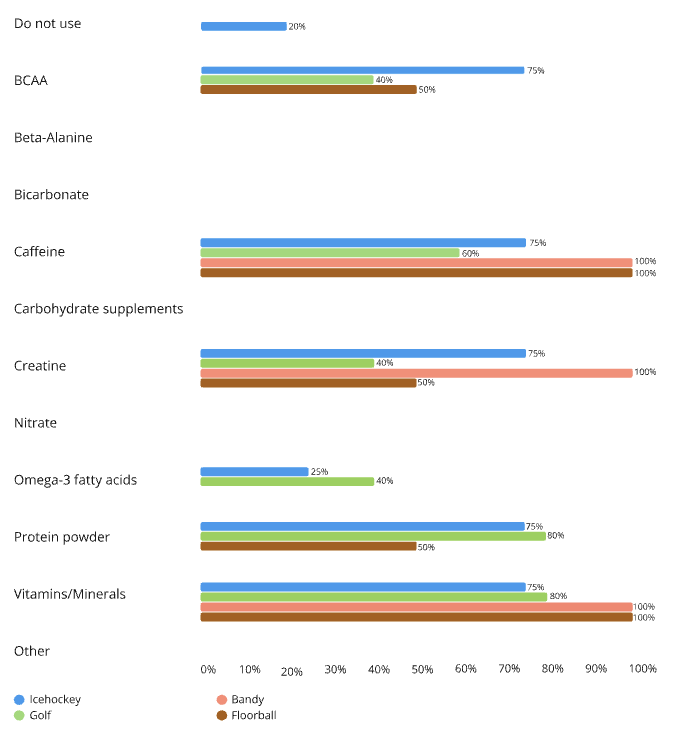
Supplement use
- An analysis of supplement use revealed clear differences between athletes.
- Creatine and BCAA were used twice as often by men, while women more frequently used omega-3 and carbohydrate supplements.
- Caffeine was the most common supplement across all competition levels and increased with higher levels, suggesting its use as a performance enhancer.
- Vitamins and minerals were consistently used at all levels, whereas protein powder and creatine were more prevalent among international- and top-level athletes.
- Those not using supplements were mostly at regional levels, while carbohydrate supplements were almost exclusive to athletes with very high energy demands.
Dietary challenges
- The biggest challenge for athletes across genders was meeting energy needs, particularly in sports such as handball, athletics, golf, football, swimming, and triathlon.
- Secondary challenges varied: men struggled more with protein intake, while women cited time constraints. Eating disorder concerns appeared only among women in cheerleading.
Nutrient tracking
- Most athletes tracked their nutrient intake in similar ways regardless of gender.
- The only notable difference was that only women reported using structured meal plans or diet schedules, indicating a more organized approach to planning meals.


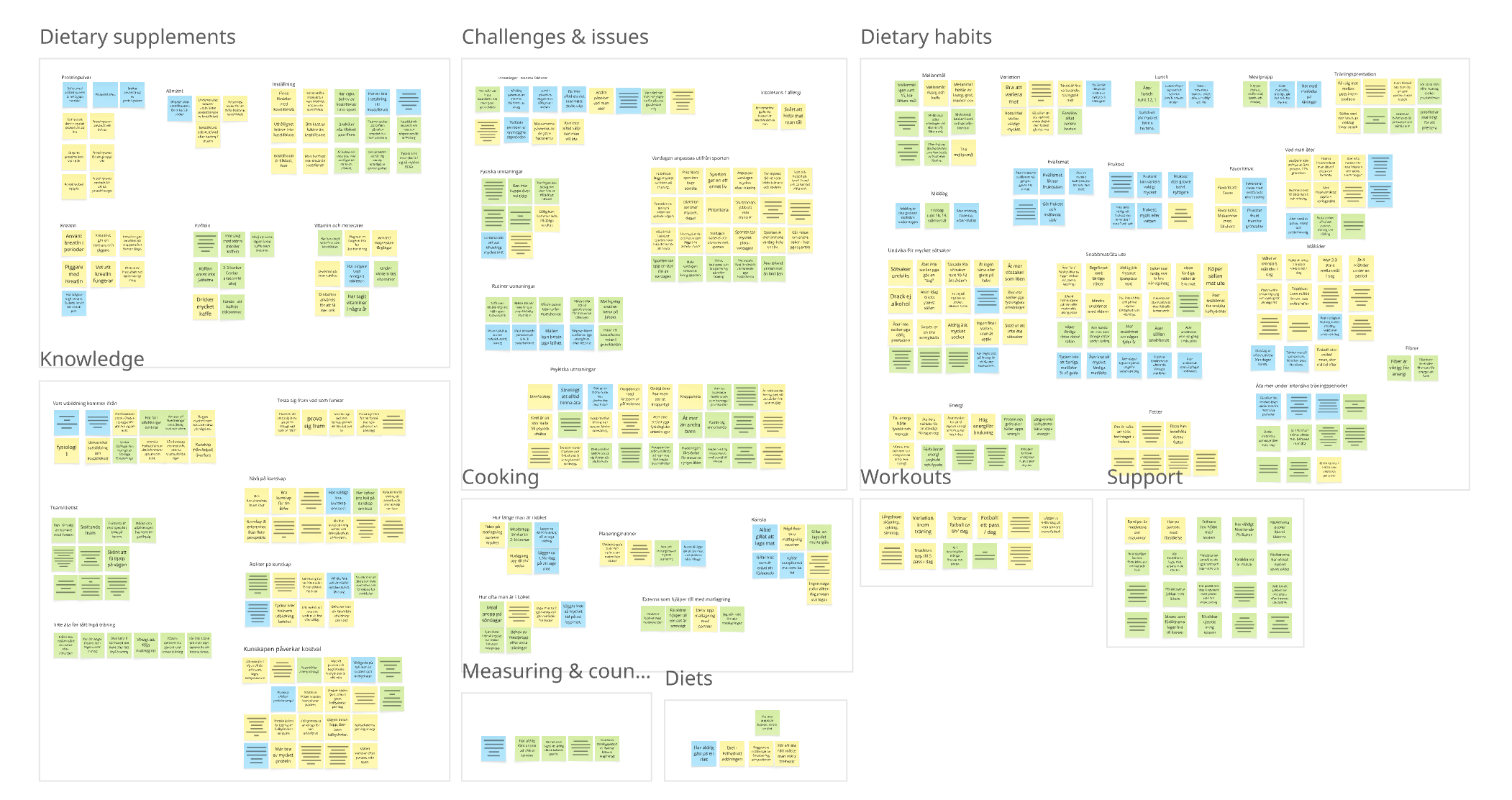
A snowball method were used to identify potential interviewees, ultimately conducting 3 semi-structured interviews. I organized and conducted one of the three interviews along with one observer taking notes. An interview guide was followed, structured around four themes: Introduction/Warm-up, General Eating Habits, Supplements and Diets and Challenges. All interviews were conducted in person, recorded, transcribed and coded for analysis.
Responses were coded and clustered in Miro, with different colors representing different interviews. Clusters were refined into categories and named to reflect their content. This process highlighted recurring topics and patterns across participants.

Supplements and diets:
- Commonly used: creatine, protein, vitamins/minerals, caffeine; some preferred natural sources.
- Carbohydrate loading was rare, mostly for endurance athletes; supplements were often seasonal or situational.
Eating habits and nutrition strategies:
- Strong nutrition knowledge; meal prepping simple, nutrient-dense meals prioritized over calorie counting.
- Home-cooked meals preferred; energy intake adapted to training and sugar intake consciously limited.
Challenges:
- Physical and time challenges: meeting energy and protein needs during intense training while balancing daily life.
- Social and psychological pressures: body image, exclusion, and limited healthy food options.
Sport-Specific Differences:
- Endurance athletes focused on carbohydrate timing; strength athletes on protein/muscle building.
- Aesthetic and weight-sensitive sports showed higher risks of restrictive eating or energy deficiency.
Support Systems:
- Family and partners aided meal prep and healthy routines.
- Early parental support influenced long-term nutrition habits.
Nutrition is central to performance and recovery, but athletes face both practical (time, availability, meal planning) and psychological (body ideals, social pressure) challenges. Individual strategies are highly influenced by sport type, training intensity, and personal support systems.
In this project, I had the opportunity to work with a highly niche target group - elite athletes. Designing for users with fundamentally different habits, routines, and mindsets required an open, reflective approach and a willingness to challenge my own assumptions about daily life and motivation.
The project highlighted the importance of tailoring research methods and language to users with specific needs and a high level of domain expertise. At the same time, it reinforced the need to account for significant variation within a target group that may initially appear homogeneous.
The low survey response rate required a careful and transparent approach to drawing conclusions and presenting results. I learned to clearly communicate methodological limitations without diminishing the value of the insights. The project reinforced that UX research often involves working with incomplete data and making informed, responsible interpretations.
I have also become more aware of how my own background and lifestyle could influence both question design and data interpretation. By applying thematic analysis and affinity mapping, I ensured that user perspectives guided the insights rather than my own assumptions, strengthening my reflective practice as both a researcher and designer.
I have gained experience and developed stronger skills in identifying design opportunities early on, as well as continuously throughout the process. I found it particularly valuable to formulate insights that provided a solid foundation for future design work, while also validating emerging ideas and hypotheses along the way.
I also gained experience working in a structured manner with complex and sensitive information. This strengthened my confidence in research-intensive projects and in advocating for design decisions that are grounded in data rather than assumptions.